
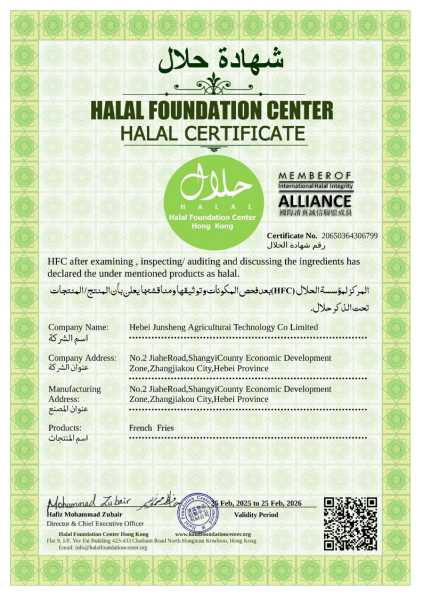
Are French fries Halal?
French fries are Halal only if the potatoes, cooking oil, seasonings, and production environment are all Halal-certified and protected from cross-contamination throughout processing and frying.
Introduction: Why Halal French Fries Matter
French fries appear to be one of the simplest foods in the world—potatoes, oil, salt. Yet in reality, whether French fries are truly Halal is a question that concerns millions of Muslim consumers, restaurants, and food manufacturers worldwide.
From our direct experience working in industrial French fries production and Halal certification, we have learned that Halal compliance is not a single decision but a systematic process—starting from the potato field and extending all the way to packaging and labeling.
This guide explains what truly makes French fries Halal, combining Islamic dietary principles, industrial best practices, and real-world manufacturing experience.
1. What Does “Halal” Mean in Food Processing?
In Islamic dietary law, Halal refers to what is permissible. For processed foods like French fries, Halal compliance depends on:
Ingredients (free from Haram substances)
Processing methods
Production environment
Prevention of cross-contamination
Credible Halal certification
In practice, Halal is not only about what is used, but also how it is handled.
2. Core Ingredients of French Fries: Where Halal Risks Begin
2.1 Potatoes: A “Pure Journey” From Field to Factory
Potatoes are naturally Halal. However, in industrial production, Halal compliance begins at the farm level, not at the fryer.
From our experience, we established a full traceability system with potato suppliers, requiring:
Complete cultivation records
Verification of fertilizers
Controlled transportation and storage
Key requirements include:
Fertilizers must not contain animal-derived components, especially pork-based materials
Pesticides must comply with Islamic dietary principles
Transportation vehicles must be physically isolated from non-Halal goods
In one case, we discovered that a transport truck carrying a potato batch had previously transported non-Halal products. We immediately activated our raw material isolation protocol and rejected the batch, preventing potential contamination.
This level of control is essential to maintaining Halal integrity.
2.2 Cooking Oil: The Most Critical Halal Control Point
In Halal French fries production, cooking oil is the single most sensitive factor.
Our oil selection standards include:
Only Halal-certified vegetable oils (such as palm oil or rapeseed oil)
Full ingredient disclosure and laboratory analysis reports
Dedicated oil storage tanks exclusively for Halal use
During a Halal audit, we identified trace animal-derived substances in one batch of oil. We immediately initiated a recall and re-evaluated the supplier’s qualification.
This experience reinforced an important lesson:
Vegetable oil alone does not guarantee Halal—certification and traceability do.
2.3 Seasonings and Additives: Hidden Halal Risks
Seasonings are often overlooked but can pose serious Halal risks.
To manage this, we built a dedicated seasoning compliance database, requiring that:
All seasonings provide valid Halal certificates
Alcohol-based solvents are strictly prohibited
Composite seasonings undergo ingredient decomposition analysis
Even small additives can compromise Halal status if not properly verified.
3. Production Environment: From Equipment to Space Purification
3.1 The “Three-Step” Equipment Cleaning Protocol
Equipment hygiene is a core requirement in Halal certification.
We implemented a strict three-step cleaning process:
Physical cleaning – removal of all visible residues
Chemical cleaning – Halal-certified detergents
Sanitization – high-temperature steam or UV disinfection
For equipment previously used for non-Halal products, we require:
Triple-cycle cleaning
Third-party laboratory verification reports
This ensures no residual contamination remains.
3.2 Production Area Isolation
Facility layout is the first barrier against cross-contamination.
Our Halal-compliant factory design includes:
Clearly defined Halal-only production zones
Physical isolation barriers
One-way material flow systems
Independent air-handling units
During certification preparation, we redesigned our entire workshop layout to completely separate Halal and non-Halal production lines.
4. Process Control: Precision From Technology to People
4.1 Halal-Compliant Process Design
We reviewed and optimized every production step:
Cutting: Dedicated Halal equipment
Washing: Halal-approved cleaning agents
Frying: Controlled temperature and time to avoid harmful byproducts
Seasoning: Applied in enclosed, Halal-only systems
Each step is documented and auditable.
4.2 Personnel Hygiene: The “Five Musts”
Human behavior is often the weakest link in food safety.
We enforce strict personnel rules:
Must wear dedicated work uniforms
Must use hairnets and masks
Must perform hand disinfection
Must receive Halal training
Must not bring non-Halal food into production areas
We conduct regular training sessions to ensure every employee understands not only the rules, but the religious and ethical importance behind them.
5. Halal Certification and Labeling: Building Consumer Trust
5.1 Halal Label Content: Three Essentials
Product labels must clearly communicate Halal status:
Visible “HALAL” designation
Certification authority information
Complete ingredient list
5.2 Halal Label Design Principles
Our labeling follows three principles:
Visibility – easy for consumers to recognize
Accuracy – verified and truthful information
Completeness – no missing mandatory details
Throughout certification, we worked closely with Halal authorities to ensure compliance with international regulations.
6. Are Frozen French Fries Halal?
In many cases, frozen French fries are more reliably Halal than freshly fried versions, because:
Production environments are controlled
Ingredients are documented
Certification is auditable
For buyers, always check:
Halal certification validity
Production facility compliance
Supply chain transparency
7. Continuous Improvement After Certification
Halal certification is not the end point.
We maintain a continuous improvement system:
Regular internal audits
Ongoing raw material monitoring
Continuous process optimization
Timely renewal of certification documents
This ensures long-term trust and compliance.
Conclusion: What Truly Makes French Fries Halal
Based on both Islamic dietary law and real-world manufacturing experience, Halal French fries require:
Verified Halal raw materials
Certified cooking oils
Controlled production environments
Trained personnel
Transparent labeling and certification
Halal is not a claim—it is a system, a discipline, and a responsibility to consumers worldwide.
FAQs about French fries Halal
FAQ 1: Are French fries always Halal?
No. French fries are not always Halal. While potatoes themselves are naturally Halal, the cooking oil, seasonings, processing environment, and cross-contamination risks can make French fries non-Halal. Shared fryers, animal-based oils, or uncertified additives are common issues.
FAQ 2: What makes French fries Halal?
French fries are considered Halal only when:
Potatoes are sourced and transported without contamination
Only Halal-certified vegetable oils are used
Seasonings and additives contain no alcohol or animal-derived ingredients
Production equipment and facilities prevent cross-contamination
A recognized Halal certification body audits the entire process
FAQ 3: Is vegetable oil always Halal?
No. Vegetable oil is not automatically Halal. Some oils may contain trace animal-derived processing agents or be contaminated during storage and transport. Only Halal-certified vegetable oils with full ingredient traceability are considered safe.
FAQ 4: Are frozen French fries Halal?
Frozen French fries are often more reliably Halal than freshly fried fries because they are produced in controlled factory environments with documented ingredients, standardized processes, and third-party Halal certification. Always check the certification label.
FAQ 5: Can French fries cooked in shared fryers be Halal?
Usually not. If a fryer is shared with non-Halal foods such as chicken, meat, or products fried in animal fat, cross-contamination occurs, making the French fries non-Halal unless strict segregation and Halal cleaning protocols are applied.
FAQ 6: Do seasonings affect whether French fries are Halal?
Yes. Seasonings may contain alcohol-based solvents, animal-derived flavor carriers, or non-Halal emulsifiers. All seasonings must be individually verified and Halal-certified to ensure compliance.
FAQ 7: How can consumers verify if French fries are Halal?
Consumers should:
Look for a recognized Halal certification logo
Check the ingredient list for animal-derived additives or alcohol
Ask restaurants about oil type and fryer usage
Prefer suppliers with transparent Halal documentation
FAQ 8: Is Halal certification mandatory for French fries?
Halal certification is not legally mandatory in all countries, but it is essential for Muslim consumers, Halal restaurants, and export markets such as the Middle East, Southeast Asia, and parts of Europe. Certification builds trust and ensures compliance.
FAQ 9: Can French fries become non-Halal during transportation or storage?
Yes. If transportation vehicles or storage facilities previously handled non-Halal products without proper cleaning and segregation, contamination risk exists, potentially invalidating Halal status.
FAQ 10: Why do some Halal French fries still fail audits?
Common reasons include:
Incomplete raw material traceability
Non-certified cooking oils
Inadequate equipment cleaning
Poor staff Halal training
Go Check our Halal certified Products
Food Safety Standards & International Certifications: Ensuring Product Quality and Global Compliance
Frozen French Fries Production Process: From Potato to Plate