
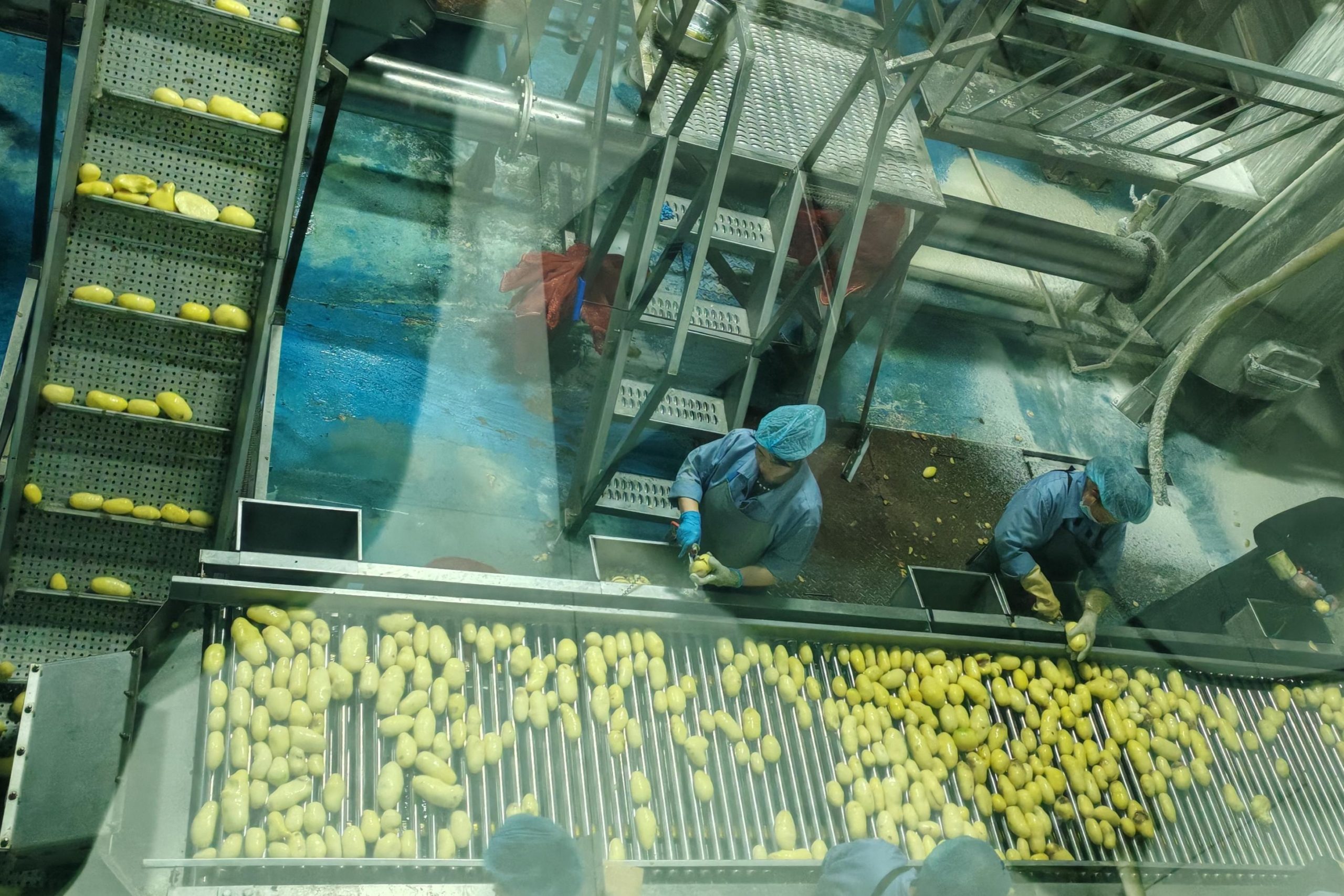
Overview of Industrial Frozen Fries Production
Although frozen French fries may appear simple, their industrial production is a highly standardized yet technically demanding process. A modern French fries production line typically includes washing, peeling, cutting, blanching, frying, freezing, and packaging.
While most professional factories today use advanced equipment, the real difference in final product quality does not come from machinery alone, but from how raw materials and processing parameters are controlled throughout the production chain.
This guide explains the complete frozen French fries production process and clarifies why quality differences remain significant even among factories using similar technology.
Read more: How to Choose a Reliable Frozen French Fries Manufacturer
Potato Selection & Storage
Potato selection is the single most critical factor in French fries quality.
Raw Material Requirements
Professional French fries production generally requires:
Processing-grade potatoes with high dry matter content
Uniform size, typically 50–70 mm in diameter
No sprouting, mold, or internal defects
In practice, mixing different potato varieties is one of the most common causes of inconsistent quality. Some varieties are suitable for table consumption but perform poorly in fries production, leading to breakage, uneven texture, or excessive oil absorption (Food Science & Nutrition, 2025).
Storage Control
After harvest, potatoes must be stored under controlled temperature and humidity conditions to prevent:
Sugar accumulation
Texture degradation
Enzymatic browning during processing
Stable raw material quality starts long before potatoes enter the factory.
Cutting, Blanching & Drying
Washing and Peeling
Modern production lines use:
Steam peeling systems, with material loss limited to approximately 4–7%
Compared to mechanical peeling, steam peeling significantly reduces waste and preserves potato integrity (Li et al., 2020)
Cutting and Washing
Potatoes are cut using high-speed water-knife (hydraulic) cutters, producing uniform strips.
After cutting, fries are washed to remove surface starch, preventing sticking during frying and ensuring even color development.
Blanching and Color Protection
Blanching is typically carried out at 80–100°C for 1–2 minutes, serving multiple purposes:
Deactivating enzymes that cause browning
Stabilizing color
Softening internal structure for better frying performance
This step plays a major role in controlling final texture and appearance (Lamberg & Andersson, 1990).
Par-Frying & Oil Control
Continuous Frying
Fries are par-fried in continuous frying systems at oil temperatures of approximately 180–200°C.
This step forms the initial crust and defines much of the final eating quality (Mujumdar & Devahastin, 2018).
Oil Removal
After frying, fries pass through vibration-based de-oiling systems, which can reduce surface oil content by over 30%, resulting in:
Lighter texture
Lower greasiness
Improved consumer acceptance
Advanced systems also include multi-stage oil filtration and precise temperature control to extend oil life and reduce waste oil generation.
IQF Freezing Technology Explained
After frying, fries are rapidly frozen using IQF (Individually Quick Frozen) technology, typically at temperatures around -35°C.
The purpose of IQF freezing is to:
Lock in structure and moisture
Prevent ice crystal damage
Maintain free-flowing product form
This step is essential for preserving quality during long-distance transportation and extended storage (Mujumdar & Devahastin, 2018).
Packaging & Cold Chain Requirements
Frozen French fries are commonly packaged using:
Vacuum or nitrogen-flushed packaging
Moisture- and oxygen-barrier materials
A stable cold chain is required throughout storage and transport to prevent:
Texture breakdown
Surface dehydration
Color degradation
Any break in the cold chain can significantly affect final frying performance, even if the product was well manufactured.
How the Production Process Affects Final Frying Performance
A common misconception among buyers is that quality differences come mainly from equipment. In reality, most modern factories operate at a similar technological level.
The true differentiator lies in:
Raw material selection
Parameter adjustment based on potato characteristics
Processing parameters such as:
Blanching time and temperature
Frying duration
Oil temperature
Drying intensity
are not fixed values. They are determined through extensive testing and adjusted annually based on raw potato quality (Li et al., 2020).
For example:
High sugar content in potatoes combined with improper frying parameters can cause excessive Maillard reactions, leading to dark color and poor appearance.
Unsuitable varieties may cause strip breakage regardless of equipment quality.
These parameters are often considered proprietary know-how, developed through long-term production experience rather than equipment manuals.
About Our HACCP and ISO 22000 Certified Production
Our production is HACCP and ISO 22000 certified, ensuring that all stages—from potato selection to final freezing—meet international safety and quality standards.
Learn more: How to Choose a Reliable Frozen French Fries Manufacturer
Common Quality Defects & Their Causes
| Defect | Likely Cause |
|---|---|
| Uneven color | Mixed potato varieties or sugar imbalance |
| Excessive oil absorption | Low dry matter or improper frying parameters |
| Strip breakage | Unsuitable potato varieties |
| Dark appearance | Excessive sugars or over-frying |
| Poor crispness | Inadequate blanching or freezing control |
Understanding these defects helps buyers evaluate whether quality issues originate from raw materials or process control.
FAQ
Why do frozen French fries quality levels vary so much between manufacturers?
Even with similar equipment, differences in potato variety selection and process parameter control result in large quality variations (Food Science & Nutrition, 2025).
Does more advanced equipment guarantee better fries?
No. Equipment is only a tool. Raw material quality and parameter optimization are far more important.
Can the same process parameters be used every year?
No. Parameters must be adjusted based on annual potato crop conditions to maintain consistent quality.
Conclusion
The frozen French fries production process is highly standardized on the surface, but deeply dependent on experience-driven decision-making behind the scenes.
While modern factories share similar equipment, consistent high-quality fries are achieved through precise raw material control and continuous process optimization. Understanding this distinction allows buyers to better evaluate suppliers and avoid quality-related risks.
Referernce:
Li, P., Wu, G., Yang, D., Zhang, H., Qi, X., & Jin, Q. (2020). Effect of multistage process on the quality, water and oil distribution and microstructure of French fries. *Food Research International, 137*, 109229. https://doi.org/10.1016/j.foodres.2020.109229
Effect of Potato Variety and Pretreatment Methods on Physicochemical and Sensory Properties of French Fries. (2025). *Food Science & Nutrition*. https://www.ebiotrade.com/newsf/2025-11/20251112001522544.htm
Mujumdar, A. S., & Devahastin, S. (2018). Impact of freezing method, frying and storage on fat absorption kinetics and structural changes of parfried potato. *Journal of Food Engineering, 218*, 24–32. https://doi.org/10.1016/j.jfoodeng.2017.08.024
Lamberg, L., & Andersson, C. (1990). Blanching, frying, freezing and final quality development in French fries production. In *Food Science and Technology: An International Journal, 1*(1).
Author: Martin Wang
Food Scientist | Industrial Processing Expert | Potato Deep-Processing Specialist
Martin Wang is a food industry expert with over 20 years of experience in industrial food processing, product development, and global market strategy. He specializes in potato-based products, including potato flakes, fries, and starch, combining biotechnology innovations with industrial-scale production. With hands-on experience in over 30 countries, Martin brings deep insight into food safety, shelf-life management, process optimization, and quality control, helping businesses deliver high-quality, globally compliant food products.