

French fries are one of the most traded frozen food products worldwide, with the global frozen potato market valued at over USD 65 billion by 2024 (Statista, 2023). For B2B buyers—whether you are sourcing for restaurants, supermarkets, or distribution channels—the question “how are French fries made in a factory?” is not only about curiosity but also about ensuring product consistency, cost efficiency, and supplier reliability.
This article offers a detailed examination of the industrial production process for French fries, focusing on raw material selection, processing stages, the impact of equipment, and the importance of using McCain potatoes.
1. Raw Material Selection: Why Potatoes Matter Most
The foundation of high-quality French fries is the potato itself. In industrial production, suppliers generally use Atlantic, Russet Burbank, or Innovator potatoes with 18–22% starch and uniform size (150–250g each). Potatoes with lower starch or high sugar levels often lead to darker color, poor texture, and inconsistent frying performance.
Comparison: Potato Quality for French Fry Processing
| Parameter | McCain Contract Potatoes (e.g., Innovator) | Local Generic Potatoes |
|---|---|---|
| Starch Content (%) | 20–22 | 13–16 |
| Reducing Sugar (%) | <0.3 | 0.6–1.2 |
| Average Size (g/tuber) | 180–220 | 90–130 |
| Fry Color Index (1–4) | 1–2 (Golden, stable) | 3–4 (Dark, uneven) |
| Oil Absorption (%) | 12–14 | 18–22 |
| Shelf Life (Frozen, months) | 18 | 10–12 |
Key Insight: Using McCain-grade potatoes reduces oil absorption by ~30%, extends shelf life, and produces fries with a uniform golden appearance. Using low-quality varieties increases oil usage per ton and leads to consumer complaints about dark color and soggy texture.
2. Industrial French Fry Production Process
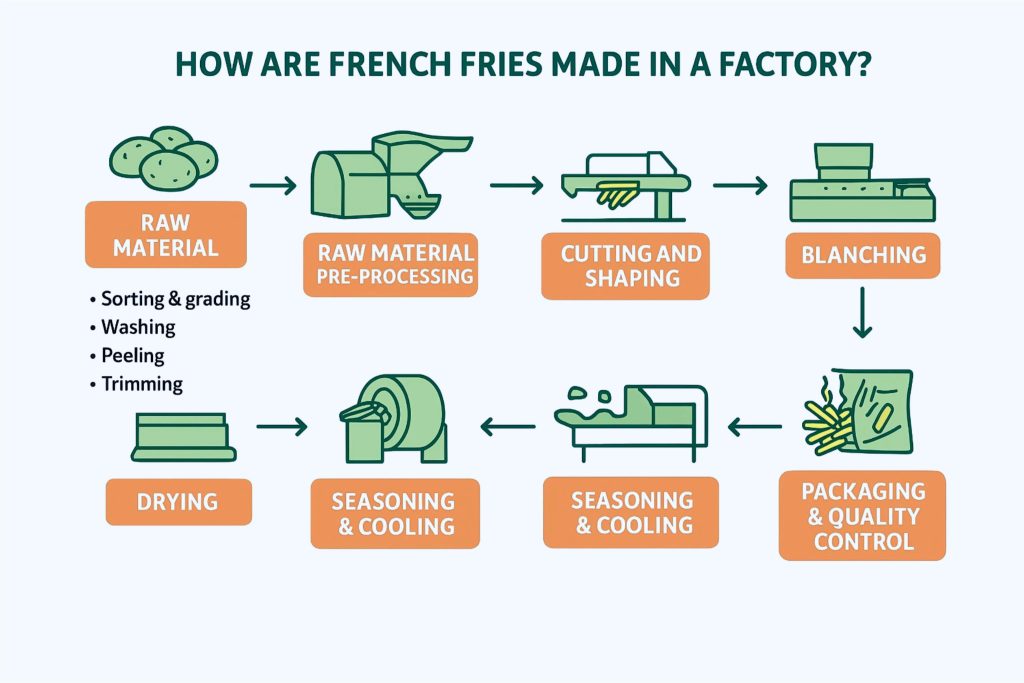
Step 1: Raw Material Pre-Processing
Sorting & Grading: Potatoes pass through drum sieves and weight graders to remove stones, soil, and undersized potatoes. Target: 98% size uniformity to ensure even frying.
Washing: Bubble and high-pressure spray washers remove residual soil.
Peeling: Steam peelers (120–130°C, 0.2–0.3MPa, 10–20s) achieve >98% peel removal efficiency without damaging flesh.
Trimming: Manual stations remove defects, eyes, and cores.
👉 Impact on Quality: Poor peeling leaves skin residues, causing black spots in finished fries.
Step 2: Cutting and Shaping
Industrial fry cutters slice potatoes into standard sizes (e.g., 8×8 mm, 10×10 mm).
Roller and knife assemblies ensure uniform length and thickness.
👉 Impact on Quality: Even size = consistent frying. Variance >2 mm leads to 15–20% higher reject rates due to uneven crispness.
Step 3: Blanching
Fries pass through water at 85–95°C for 1–3 minutes to deactivate enzymes and prevent browning.
Cold water spray (15–20°C) stops the cooking process.
👉 Impact on Quality: Removes surface starch (up to 30%) → prevents sticking and improves crispiness.
Step 4: Drying
Air knives and belt dryers reduce moisture from 75% → 60–65%.
Drying at 40–60°C hardens fries slightly, reducing oil uptake during frying.
👉 Impact on Quality: Each 5% excess moisture at frying increases oil absorption by ~7%.
Step 5: Frying
Continuous fryers with controlled oil temperature (170–180°C) cook fries for 2–3 minutes.
Palm oil or blended oils are used due to stability.
Oil filters maintain FFA (free fatty acids) <0.5%.
👉 Impact on Quality: Overused oil increases acrylamide risk and alters flavor. Filtration every 4–6 hours extends oil life by 20–25%.
Step 6: Seasoning & Cooling
Fries pass through tumblers for flavoring (e.g., salt, cheese, chili powder).
Cooling tunnels reduce the temperature to <30°C before packaging.
👉 Impact on Quality: Inadequate cooling causes condensation inside bags → soggy fries and microbial growth.
Step 7: Packaging & Quality Control
Automated pillow-pack machines or vacuum packaging for frozen fries.
Metal detectors, weight checkers, and visual inspection ensure product safety.
👉 Impact on Quality: Export buyers typically require <2% defect rate at QC stage.
3. Equipment: Why It Shapes French Fry Quality
Production equipment is as critical as raw materials.
| Factor | International Brands (e.g., Kiremko, Heat and Control) | Generic Local Equipment |
|---|---|---|
| Frying Oil Temperature Control | ±1°C tolerance | ±5–7°C tolerance |
| Blanching Efficiency | 95% uniformity | 75–80% uniformity |
| Energy Efficiency | 15–20% less energy per ton | Higher energy cost |
| Maintenance & Spare Parts | Global support | Limited support |
| Product Consistency | 98% size/color uniformity | 80–85% uniformity |
Case Example: A factory in Southeast Asia using low-grade peelers had 4% higher raw material loss (40 kg per ton). Switching to steam peelers from a global supplier reduced waste to <1.5%, saving $25,000 annually per line.
4. Process Control and Its Impact on Quality
Temperature & Time Precision: A deviation of just 5°C in frying leads to 15% darker fries and a 0.2 increase in acrylamide index.
Moisture Control: Target 60–65% after drying. Each 1% deviation increases oil absorption and alters crispiness.
Sorting Accuracy: Automated vision sorters can reduce defect rates from 5% → <1%.
👉 Buyers should ensure their suppliers have HACCP/ISO22000 certified process controls to guarantee stable product performance.
5. Why McCain Potatoes Lead the Market
McCain’s contract farming ensures:
Standardized size & starch levels → uniform fries.
Cold storage at 6–8°C → prevents sugar accumulation and dark coloration.
Longer frozen shelf life → reduces logistics waste for distributors.
Using non-contract or generic potatoes often results in:
Higher oil absorption raises frying costs.
Inconsistent fry lengths, leading to customer dissatisfaction.
Reduced export shelf life, increasing return/rejection risk.
Why the Question “How are French fries made in a factory?” Matters
The answer lies in a carefully controlled seven-step process, where potato quality, equipment precision, and process control directly determine the final product’s consistency, cost, and consumer acceptance.
For procurement managers and distributors, understanding these parameters helps in evaluating suppliers, negotiating better terms, and ensuring a stable supply of premium fries that meet international standards.
👉 When choosing a supplier, always ask about:
Potato variety and sourcing (e.g., McCain vs. local).
Equipment brands and line automation.
Quality control systems (HACCP, ISO, BRC).
Only with these checks can you secure a product that meets global QSR standards and maximizes profitability.
References
- Statista. (2023). Global frozen potato market value. Retrieved from https://www.statista.com
- FAO. (2022). Potato processing and trade data. Food and Agriculture Organization of the United Nations.
- European Food Safety Authority (EFSA). (2021). Acrylamide risk assessment in fried foods.